Hey, this is the third (and probably final) part of my Worldbuilding in Minecraft idea posts. Part 1 focused on early simple gameplay ideas, while Part 2 focused on more complex gameplay ideas and infrastructure projects. This part will be taking a further step back (or up? and out?) to focus on more 'meta' stuff, world lore, and external communication/information. As with the other posts, this is based on my experience with an unmodded vanilla Bedrock server setup.
I have now created an 'Addendum' post for any further ideas or useful stuff I find.
Sections
Controlled Drama, Friendly Rivalry, and Organic Lore
External Communication/Information
NPCs and Commands
I only found out years into playing the game that Bedrock Minecraft has programmable NPCs built in, with no modding required. They are totally static characters that stand wherever they are spawned (with a specific spawn egg that must be generated by a command) and can't be killed/deleted except with admin powers. You can program them to have text dialogue when clicked on, with four text inputs to choose from, and have them respond in world chat or a direct message to the player that engaged with them. These can be expanded upon with commands to create more dialogue options and dialogue chains (by chaining further hidden NPCs nearby), as well as creating a 'trader' or shop NPC (essentially spawning what you 'bought' in your inventory and deleting the 'currency/barter').
A very simple use of this mechanic is creating information/exposition NPCs scattered throughout the world like innkeepers, librarians, and guildmasters. This gives players a more interactive way to learn about a local area or the facilities available in a relevant structure (inn, library, guild hall). Beyond this, the trading or shop style NPCs can be a bit more complex to manage without causing harm to your world, but do have their obvious benefits. Patience and balance are key when creating and managing traders, as the prices and items offered could severely effect gameplay loops and the world's more traditional trading setup (skilling villagers, and travelling merchants). It also must be taken into consideration that you aren't giving certain settlements/regions unfair advantages over others, while also making traders 'worth travelling to'.
I can't really do justice to explaining all that can go wrong with economic mismanagement in (even micro) virtual worlds, but you see frequent issues like this in all the biggest MMOs, where a slight balance change vastly effects the 'meta'. It is important to remain realistic and understand that if these commerical offerings can make those mistakes, with their millions of dollars and thousands of employees, you as an individual or small admin team are capable of the same. You also must be careful and thoroughly test commands for shops in an isolated single player world before implementing them in a server with others. There is potential for syntax errors to totally wipe a players inventory instead of the one currency/barter item.
Example NPCs
Below are two fairly simple examples of NPCs I have made in my Bedrock Server, with their associated code. NPCs are spawned via the 'NPC spawn egg' which can only be obtained with the command '/give @s spawn_egg 1 51' (as admin). ONE down side to this is that texture packs may not have custom NPC models, so you will have vanilla ones floating around your stylized world (is the case for us)
Innkeeper
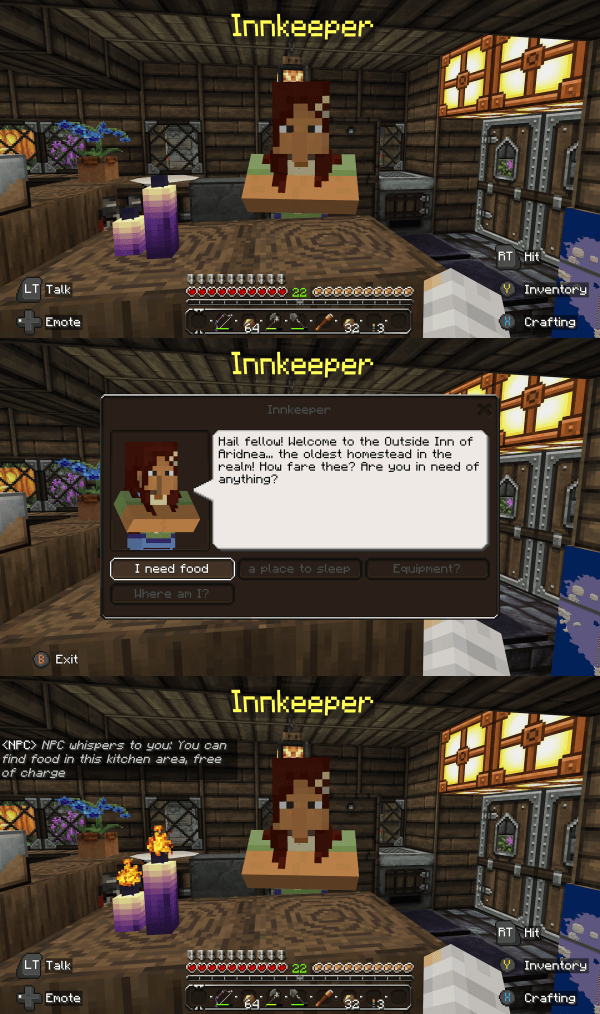
This was the first NPC I created, in the spawn town's main inn. It is a information exposition dialogue NPC that tells you where you are (the inn) and asks if you need anything, with the response options of:
- 1. I need food
- 2. a place to sleep
- 3. Equipment?
- 4. Where am I?
These in turn lead the NPC to respond directly to the initiating player (@initiator) via a whisper chat messge, so that responses don't spam global chat. The relative responses are listed below:
- 1. You can find food in this kitchen area, free of charge
- 2. Head upstairs! there are plenty of beds available for lodging
- 3. If you head downstairs you will find a large amount of complimentary gear to help you get started.
- 4. This is Aridnea City! the genesis of the realm... you will see a local map on the wall here, and there is a local guide book just outside the front doors
This is all done within the graphical NPC management window that pops up when you 'use' an NPC whilst in admin/creative mode. It allows you to add up to four dialogue button options and an associated command that clicking the box executes. In this case, the commands are simple '/tell @initiator (dialogue here, without brackets)' that whispers the response directly to the initiating player. See it in action with the gif below;
Exchanger
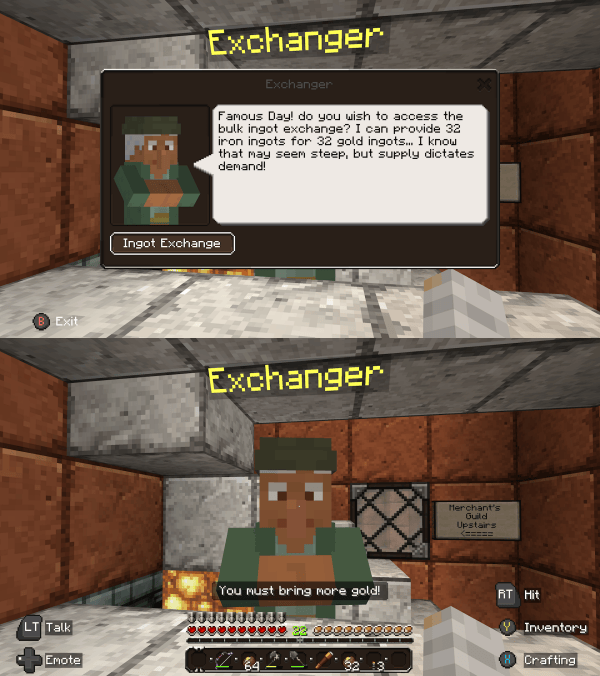
This NPC is a trader that lives in our spawn town's bank, it exchanges 32 gold ingots for 32 iron ingots. I figured that this would be a fairly balanced exchange as gold is more scarce, but iron is far more useful and always necessary. If there is an abundance of gold but iron is NEEDED this becomes a useful, but not game breaking, trade. Otherwise the NPC will sit there dormant when not needed. When interacted with it has a speel explaining the trade on offer and comments on the price being steep 'but supply dictates demand', with the only option being: 'Ingot Exchange'.
I am pretty sure I followed (and slightly edited) this video guide for this shop NPC. The command essentially checks if you have 32 gold ingots, which will be deleted from your inventory and 32 iron ingots will be spawned in. If it does not detect the correct amount of gold, a 'title' message displays on-screen that reads 'You must bring more gold'. See the gif below for the opening dialogue and failure message, the full command text is in plaintext here (actually forgot I added the villager haggle sound to this).
Going Further With Commands
There is a lot more stuff that can be done with commands in Bedrock Minecraft, which in turn can add many mod-like changes to the world and gameplay. I have only encountered this kind of stuff in guide videos online and not personally tested them, but I'll share some interesting looking ones:
- Making 'hero abilities' or a magic system by applying commands to objects
- Creating a custom world boss event
- Create a teleporter
- Create NPC Quests with unique quest items
Those are all from one channel (gabedala) that I came across and stuck with because the guides were simple and to the point. Minecraft is arguably the most popular game on earth though, so you should be able to find many guide videos from many other channels to suit your vanilla command modding needs. Consider using Freetube/Newpipe/Pipepipe/Materialious!
Controlled Drama, Friendly Rivalry, and Organic Lore
I think it is a bit redundant to say 'add lore and roleplay to your world', because that comes naturally if you are interested in that playstyle, and if you aren't then you won't be reading a post called 'worldbuilding in minecraft'. Instead, I am using the terms 'controlled drama', 'friendly rivalry', and 'kayfabe', to describe a mixing of them in order to create semi-pre-determined organic stories. I say 'controlled' drama and 'friendly' rivalry because it should elucidate similar feelings to real drama/rivalries without being genuinely distressing, and 'kayfabe' because this is a mostly pre-determined narrative 'performance' that should not effect real relationships. I think it could also be described as light DM-ing; injecting story or gameplay into a world but allowing it to evolve with player interaction. I struggled a bit with how to word all of that, but hopefully one of those terms makes it make sense. And of course you can engage in full scale DM-ing and lore creation in your world, but I am writing this from the perspective of running a small casual 'friends' server, where that kind of thing might be a bit too much effort/beyond scope.
Anyway, the implementation of this depends on your world and it's players. If this is on a small private friends-only server, you likely know the other players very well, the types of things they like or dislike, and their levels of maturity and engagement. If this is on a server with people you don't know, this may require more patience and consultation with others. You can have all the 'friendly' and 'controlled' intentions in the world and still genuinely upset people with problematic stories/lore, and unbalanced gameplay mechanics that you create. With this in mind, I will go over a couple examples of this kind of stuff from our world.
Low-Stakes Rivalries
I have touched on these two examples before in the 'Sports' sub-section of Part 1, and the 'Businesses' sub-section of Part 2. These are meant to be silly throwaway rivalries that help build up a bit of backstory to small elements of the world.
Competing Businesses
One of the original three players of our world created a cake bakery called 'Psymart' very early on, building one in his town as well as the spawn town. Some time later I created a pumpkin pie bakery called 'Good Gourd' and put up not-so-veiled slanderous signs denouncing his shops pricing and farming practices. I then decided to build Good Gourds in as many settlements as possible as direct 'competition' to Psymart, and anywhere he would build a new outlet, I would follow immediately. I think the peak of this was my friend building a Psymart in a really interesting spot hanging off a hillside on stilts, so I came along after and built a 'concept store' Good Gourd that's a giant glass pumpkin to 'outshine' Psymart. We are the two most active players, and this has just been a funny way to take little meaningless jabs at each other, when we are bothered to engage in it. The 'businesses' aren't actually functional, everyone basically shares everything in our world anyway, so they are more of just a timewaster project.
Sports Leagues
I figured this would be a fun way to engage in meaningless competition, similar to how real world sports are ideally meant to do the same. Just like the real world, you can support some random team based in some random town or district that you may not even live in, and go through similar ups and downs depending on their performance (most neurodivergent explanation ever, lmao). In our world, the main 'sports league' is based around Spleef, a popular sport endemic to Minecraft and it's gameplay mechanics. I converted an arena in our spawn town to accomodate the sport and put up livery all around to decorate it for the league, while also adding signage explaining the game/league, and notices in the town newspaper/noticeboard.
When creating the teams I followed the same kind of 'mirroring natural progression' thing that I have applied to other concepts in our server (like travel infrastructure). Many real world sports leagues start in one populous city or district before expanding with their popularity to be provincial, national, or international. With this in mind, I created two teams in the spawn town based on two distinct districts; 'Citadel' the oldest and most built up section which contains the world spawn, and 'Southwatch' which is a more recently built area also centred around a castle-like area that sits on the south side of town. I considered adding more districts, but thought it would be simpler to start with two, it does provide an incentive for me to add more to the spawn town though in order to have more distinct sections with which to base a team in/create livery for.
The livery I made for the sections was simple and kept in line with the iconography of the spawn town; a white saltire over a base colour (purple for the city istelf), so I used red for Citadel as that area has granite walls, and black for southwatch as it is mostly made of deepslate. I did also build up another section of town more that uses mudbrick heavily, and could add that to the league with a brown colourway in the future. Beyond that, as the game becomes more popular I could help other players build arenas in their towns and expand to a worldwide league, giving the spawn town's one more of a 'minor league' feel.
As for the actual gameplay, I just allowed whoever was around to play for whatever team they wanted, as Spleef is a pretty reasonably fair game. There is certainly skill to it, but it's also very dynamic with a lot of 'moving parts' (or broken blocks) that I can't clearly say anyone is better than anyone else in our server, regardless of platform or connection speed. This ends up making each game genuinely exciting with an unpredictable outcome, which has worked in favour of my goal for this to be meaningless but balanced rivalry fun. I also left it as 'choose whatever side you want' in order to kayfabe my way into Southwatch winning the season, as a means to familiarize players with the new district, but it genuinely won without intervention, and it wouldn't have worked anyway as it was impossible to 'fix' games XD
Spirituality Systems
I'm not religious and neither are any players in my server, our attempts to create spirituality systems are another instance of us mirroring natural progression of the real world or other games/fictional works. In the early days of the server, one of our core players founded a town on an abandoned village far from spawn that had a church. He patched it up and built a large pyre with a campire on the roof, while also having to rapidly build walls and a moat around his village because it bordered desert (so he was under attack by husks during the day, and everything else at night). Lighting up the area with torches helped keep the night at bay, but there was also a pillager outpost nearby that we went and raided by setting on fire. With all this in mind, fire naturally became a pretty big symbol of safety for this town, and he ended up centreing the church on this idea and calling it 'the church of psyche'.
Some time later, another of our core players decided to create a giant tree high into the skybox limit and called it the 'gaia tree'. Later I assisted in building a gaia tree sanctuary into the rock base that the tree grew from, and we declared that harvesting resources in that entire region was prohibited as it was protected by gaia. This had the added benefits; the area was pretty barren anyway, so wood was hard to come across and structures would uncomfortably stand out in the open tundra, and it also gave a hard eastern build limit for the spawn town (from which the tree can be seen with decent enough render distance). This became the primary spirituality system of the spawn town, but is not necessarily a 'church based' one, more of a divinity in nature base. This works well with the game itself I feel, as the server itself is the 'ultimate life giver' in the context of a person living within it.
Both of these examples being created by other players has been good for organic lore/worldbuilding seeing as I am not the one directing it all as the server runner. If I have ideas that I think could work with/add to what they created, I can chime in and add my two cents while leaving the ultimate design and progression up to them. It's interesting that they both coincidentally represent two sides of the reality of minecraft, life and creation in Gaia, death and destruction in Psyche. Some questions and progression ideas that I did have (heavily influenced by The Longest Journey Saga and Star Trek) are:
- What if these two are deities (Psyche & Gaia) and are 'required' to exist in balance of each other, a chaos to compliment order type thing.
- What if they are two sides of the same presence, being interpreted differently by different 'cultures' (towns), in a what is life without death? what is death without life? type thing.
- Are they beings/prescences at all or did WE create them? on the other hand are they 'simply' beings beyond our comprehension that we, in our limited understanding, apply these associations (life, earth, fire, death) to?
- Is my questioning and reinterpretation of both of these systems actually just me creating a new ecumenical denomination of them? (interesting idea, but I have no desire to pursue it).
- What does the progression of this look like? do we eventually find out it is server code and go down a sci-fi 'simulation' route? or do we interpret those findings how the real world interprets physics and base elements, or how a fantasy world interprets magic? OR do we stick to our belief systems and comprehend it as an extension of those?
- What is my role as the server manager? in a sense I created the the world, or at least the current iteration, it was originally a realm payed for by another member who passed on the save file to me for self-hosting. What is his role as the original creator? We both have admin/operator status and are able to create and destroy matter at will, but choose to not use these powers (are we hiding it from the others?). Also, seeing as he created gaia, is that the true path? or should psyche be considered so due to that player's much higher engagement in the server?
- I have considered and partially planned a method for players to follow a series of clues/quests that would lead to their character 'understanding' the nature of creation and gaining the 'powers of gaia/psyche' (admin). This would not be a clear and easy path to follow, aiming for an original implementation of jedis in star wars galaxies kinda thing (which was projected to take literal years of gameplay to work out before executives stepped in and said "we need a way to become a jedi by christmas"). This may involve one or both of the deities being represented by an NPC in world (that I program with dialogue) or I also considered an alt account where I act as them (matrix online style)
- I have also partially planned/considered a method of players creating their own spirituality system, with maybe a minimum of adherents/worship structures, in order to access the same 'powers of the gods' pipeline. Again, this would not be explained in world and more left as a surprise reward for the genuine worldbuilding of players.
These are all just a bunch of lore threads that I have considered and jotted down, or shared with the others on server. Most of them are a bit beyond the more casual nature of our gameplay, but have been fun ideas to work on with the others, and may come to fruition in the future.
War System
This can be difficult to ideate in a balanced way regardless of your server population. If there are a lot of players, it may be easier to organise a time and place for 'skirmish' style all out battles between towns or factions, but that can be hard across timezones or between work schedules. The scheduling issue can be worse for a small population, as well as player engagement often being lower overall. If you've ever played an open pvp survival mmo, or just any large public minecraft survival server, you know the feeling of waking up/logging in to your hours of hard work destroyed and probably don't want to facilitate that for others, especially friends. For these reasons, I tried creating an asynchronous-to-turn-based strategy game style war system with another player on our server, with some okay results.
I'm basically going to do the 'explaining a board game' meme so good luck reading this I guess. Towns form the basis of the warring factions, with territory in between them being where the 'war' stuff takes place. One town (attacker) can issue a challenge to another, and build a fort in the (unbuilt/unused) territory between them that it wishes to claim. The second town (defender) then has to build their own fort on their side of the contested territory. The forts can be built out of anything and in any way, also I gave no real time limit for this section, but maybe a week or two would be good. It allows either player to have the time to build whatever defences they want in an asychronous manner (at separate times). Once both sides agree, or the time limit ends, they enter the actual battle phase, which is turn based. I figured turn based might be a bit more fair as a highly skilled PVPer could just dominate a real time fight. The defender must go first and make an attempt to penetrate the attacker's fort and kill the attacker without dying themselves. One death (or maybe mmultiple 'lives' if we did more testing) would end their turn, and send the defender back to defend their fort. It would then be the attacker's turn to do the same, and if they die/lose all their lives, then the turn would go back to the defender. Whoever is defending their fort ('attacker' player or 'defender' player) would only have one life, which would force them to play more conservatively/defensively.
After one side 'loses their fort' by dying in it, that is a victory for the other. Depending on the size of territory between the two towns, you may want to repeat this process for multiple sections of land, or if it is a small area it can just be done one time. Once one side is pushed back to their own town, that can be the end of the 'war' or the player can put their town on the line as a final 'fort'. If won, the 'final fort' town could push the war back into the forts/territory claim section, and if lost then the town would be forced to capitulate to the other side/be absorbed. We made this part a choice, as it may prevent someone from using the system to just invade everyone around them. There are some other ideas that I think would work with a more turn-based battle/war phase that we didn't end up implementing in our test:
- Placing the combatant players into 'adventure mode' so that they can't just mine or dig into a structure, and may be forced to build siege engines (TNT or fire charge dispensers) in order to break into a fort, or a means to launch themselves over a wall safely.
- Making certain actions 'exhaust a turn' like crossing a river or building a siege engine/small structure, and maybe limiting movement per turn to a certain amount of blocks.
- Maybe a gear limit, like only iron stuff, so that 'wealthier' players are not at an unfair advantage rocking full enchanted netherite.
- I specifically didn't make any rules as to what 'can or can't be done' during war, but this may provide for interesting interaction/world building post-war. Maybe declaring certain things as unlawful like the use of animals or certain traps. This could also provide a means to create a 'world congress'/UN type thing in your world, if interested.
In our test, I just based myself in a random village and issued a challenge to my friend's town, then built a wooden fort and placed dozens of traps around ('barbed wire' thorn bushes, TNT pressure plate/detector mines, sand traps, fire charge/arrow dispensers). He didn't have a lot of time to build his own fort so we just went all out (I was planning to lose anyway), I managed to get him a few times with traps, then a fire charge lit my own fort ablaze and we were PVPing while it burnt down around us. I then offered the village up as my 'final fort' which I had laced with grass and leaves (to set alight), and more mines, eventually he finished me off there. This was a fun time, and a fun way to bring it all to an end.
External Communication/Information
This section is about facilitating other means for players to communicate and access information asides from being online and in world chat, as that has it's limits. Below will just be some notes on ways to achieve this, pros and cons of some, and a bit of general rambling.
Text Communication
These require moderation which can be annoying depending on the population size of your server, but if it's just your friends that shouldn't be an issue. They can be a good place to drop static messages than everyone can see, like in any forum. One tip; let the channels grow based on what's wanted/required, it can be overwhelming to join a new small personal server to find it has 20+ channels (more than the number of members).
Discord: We had one for our server, but I don't really like this platform because; no data privacy, a lot of stuff is paywalled, I hate the UI, it's resource intensive, needs updates every three seconds, will probably integrate AI soon, etc and so forth. The only thing it 'offers' is that 'everyone' has it, so good luck convincing anyone to use another similar thing (genuinely, I hope you succeed). This also means it is integrated on more devices and dominates this scene, with many sites (and companies) replacing all their RSS, forums, and support with 'just join da discord'. On larger discord servers, you will usually see 'announcement' pages, and there is an option to share their feed with a channel on your personal server. I used to use this to pull update announcements from the minecraft discord (so I don't have to join it and get phished/solicited by hundreds more people than I already do), and the announcements page of the texture pack we use; dokucraft, but ended up ditching this as most of the Minecraft updates were spammy and useless. EDIT: Since the ID verification thing we don't use this anymore, and I don't recommend anyone else do so either.
Revolt/Stoat Chat: Like open source discord with less features and almost nobody uses it. The UI is similar (bit less annoying imo) and it does similar 'channels' type stuff with text or voice, does not have a 'threads' feature though, but it's otherwise like a drop in replacement.
Teamspeak: Like discord but older and more voice oriented than text (and does a better job at voice). It does have text channels though, free personal servers, is apparently more privacy forward and less spam filled. Another perfectly fine drop in replacement for discord.
Matrix/Element: open source communication software, can be a pain to run and host, has text and voice channels though. Might be more relevant if I wrote a 'worldbuilding in luanti/minetest' post (this joke is open source).
Others: You can also make simple group chats in many other chat apps like Signal, and Telegram allows the creation of 'Channels' where you could post server updates and have players follow that.
Free forum hosts: Theres a couple out there like Boardhost and ProBoards, and some free software to host your own like phpBB or MyBB (on your own site host, so not free). They should be public facing, but have options to hide the content from anyone that isn't logged in. I really LIKE forums as a concept, if only for the fact that they are slow and static while able to remain public facing without an account. It can be hard to get a small community into using it though, many people now aren't used to using sites outside of big social media and related, so it may not be worth the effort.
Mailing List: Pretty old school, but still used by a lot of old school people/groups. Modern problems with this are; privacy of you personally holding onto your players email addresses, 'nobody' checks their emails anymore because its 99% spam or phishing. It could be a novel way to send updates to your players though, or to send out a regular 'newsletter' thing.
RSS feed: Same as mailing list, except people opt in to reading it by following your feed in a feed reader (most mail clients can do this, as well as dedicated apps), and you don't have to hold onto their emails. Again, 'nobody' will willingly use this these days, but it is novel and could be fun to do. You do need to host the feed on a website though (Neocities/Nekoweb are free), and create the RSS feed (RuSShdown is simple to use), and run it through a feed validator to make sure it works, and also explain what any of this is to every single person you are asking to use it XD
Make a Website!
I've written multiple times across my site/posts that my dislike of discord is what motivated me to get into neocities by creating a website for my minecraft server; rainydisco.neocities.org. Making a site that is personal to your server can be really fun and give it a bit more character, while acting as another source for lore building and information. As mentioned before Neocities and Nekoweb are free and relatively easy to use, but there is a near 100% chance you got to this post from a Neocities feed/search/link so you already know this. For our site I used two eggramen layouts; the 'busy generic - chalkboard' on all pages except for the news which uses 'noodle soup times'. They are both pretty easy to read and understand, especially for me as a beginner. I'll just briefly outline the sections I added and potential expansion ideas for them below:
- Home - generic index/about page that also displays current server settings and status (I manually update this live if I have to turn off the server for any reason).
- Realm News - a newspaper (The Realm Observer) that is a mix of in world and meta server news.
- Townships - Currently a list of all settlements in the world. I plan to eventually make separate pages for each major town/region, and showcase videos to accompany some of them, in consultation with the other players. Will add unique background images when I do town specific pages.
- Travel - just lists stops/locations along major travel routes (roads, rails, canals). Might make more specialized maps for this at some point, but unsure how to style them.
- Guilds - a hub page for the three guilds (Adventure, Mining, Merchant), containing a bunch of information and guides relevant to each (like a mine rating/location list, or tips for villager trading).
- Library - just a list a brief descriptor of each written book present in the world.
- Maps - just maps of the world and spawn town. I plan to make a larger medieval fantasy themed map showing known expeditions outside of the mapped world.
- Troubleshooting - some tips for the players if they encounter issues with game stuff like connection or textures, and are unable to get in touch with me to solve them.
- Resources - a big resources list for anyone, covering gameplay, worldbuilding, technical stuff (server hosting, bedrock connect), image sources that we use (like 'our' tree logo thats from opengameart), and a bunch of build guides (that I was spamming in a discord channel before).
- Future Additions: I mentioned videos before, one of our players is keen to do music for them, I am just trying to work out what to make. Probably showcase-type videos for a bit of fun between ourselves, have been meaning to make one about defeating the ender dragon/5 year anniversary too. We'll see!
Thanks for reading this loooonnggg post! As I wrote in the intro, I think this will be the end of these as I have exhausted all ideas I have. I wrote these for fun because I wanted to, and also I just like to get stuff out of my head so I'm not the only one holding on to it. I also really like reading other people's blogs and coming across a totally different way of approaching something I'm into, so hopefully these can do the same for someone else :)
EDITED 17-03-2026: Striked the Discord section, it was already mostly negative but I wanted to be clear that I don't recommend it or use it for this purpose anymore.